
Why Air Quality Improvement Portland Matters Now More Than Ever
Air quality improvement Portland programs focus on reducing emissions from transportation, buildings, and industry while protecting residents from seasonal threats like wildfire smoke and winter inversions. The city aims to cut carbon emissions 50% by 2030 and reach net-zero by 2050 through electrification, cleaner energy, and building performance standards.
Key Portland Air Quality Programs:
- Climate Emergency Workplan – City-wide carbon reduction strategy targeting buildings and transportation
- Portland Clean Energy Community Benefits Fund (PCEF) – Voter-approved funding for climate initiatives focused on disadvantaged communities
- Building Performance Standards – New requirements for carbon emissions, indoor air quality, and temperature in existing buildings
- Zero-Emission Vehicle Mandates – Oregon targets 3.3 million EVs by 2025, 100% by 2050
- Wood Burning Restrictions – Multnomah County bans wood burning during poor air quality days
Portland’s air quality has gotten worse since 2016. After two decades of meeting EPA standards for all six criteria pollutants, the city now averages 3 unhealthy pollution days per year. The American Lung Association downgraded Portland from an “A” to a “C” rating for both PM2.5 and ozone pollution.
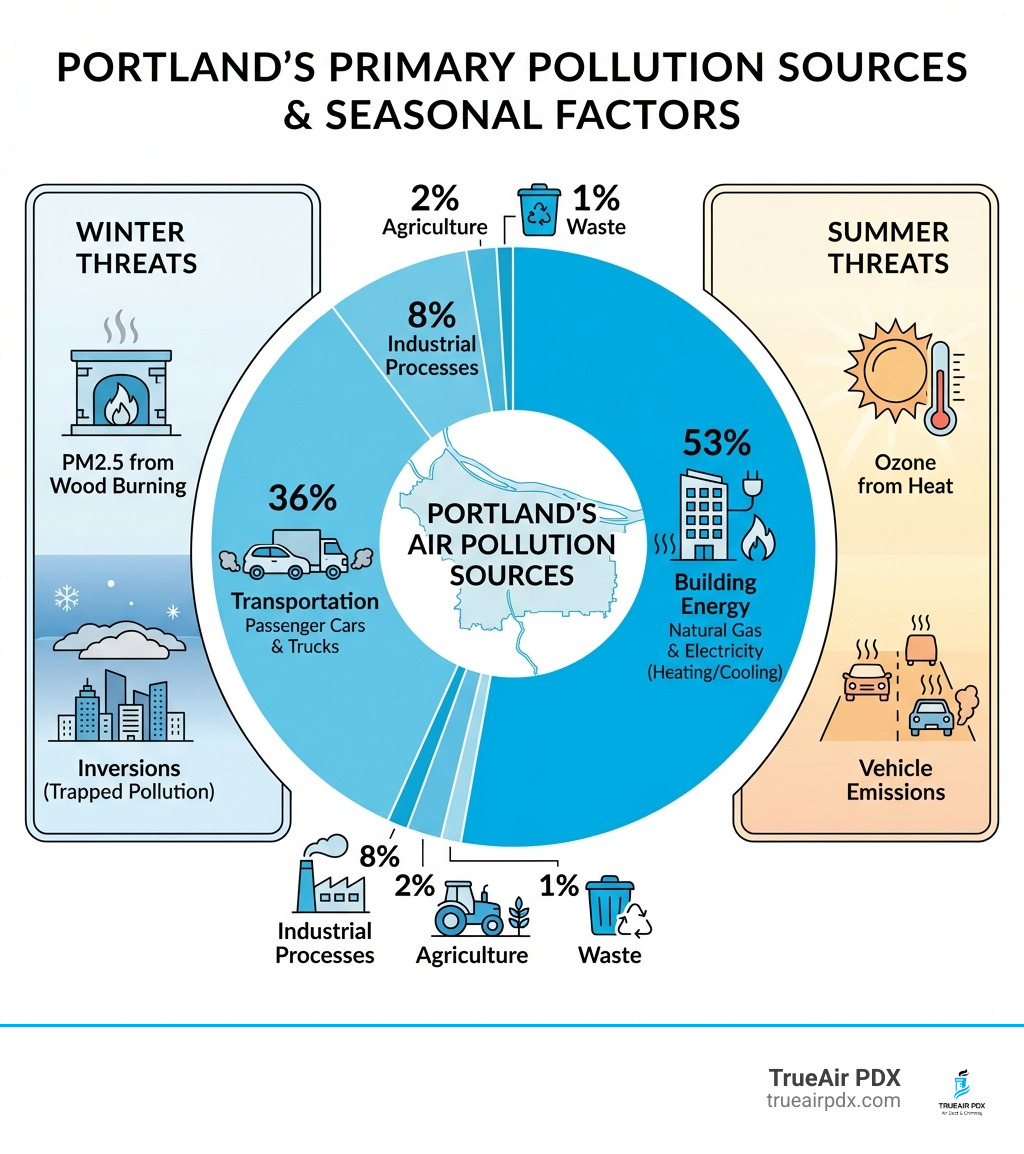
The problem hits close to home – literally. Nearly half of Portland’s carbon emissions come from heating, cooling, and powering existing buildings. Add in wildfire smoke that travels hundreds of miles, temperature inversions that trap pollution in winter, and hot summers that create ground-level ozone, and you’ve got a city facing serious air quality challenges.
But here’s the good news: Portland has a plan, and residents can take action both inside their homes and as part of broader community efforts.
The State of Portland’s Air: Pollutants and Trends
For two decades, our city proudly met the Environmental Protection Agency’s (EPA) air pollution standards for all six criteria pollutants: PM2.5, PM10, ozone, carbon monoxide (CO), nitrogen dioxide (NO), and sulfur dioxide (SO). This was a testament to the regulations and a shift towards cleaner energy that began making significant gains in smog reduction back in the 1970s and ’80s. However, since 2016, we’ve seen a concerning trend: Portland’s air pollution levels have been climbing.
In the 2016 to 2018 monitoring period, Portland averaged roughly 3 unhealthy pollution days a year, a noticeable increase from less than 1 unhealthy day a year just a few years prior (2014-2016). This decline earned us a “C” grade for both 24-hour PM2.5 and 24-hour ozone in the American Lung Association’s (ALA) 2019 State of the Air report, a slip from our previous “A” rating. The ALA even ranked Portland among the top 25 cities with the most short-term particulate pollution.
Our primary air quality culprits are fine particulate matter (PM2.5) and ground-level ozone. These two pollutants contribute almost equally to our unhealthy air days, with 1.5 days attributed to ozone and 1.3 to PM2.5 pollution.
Seasonal Factors: When Portland’s Air Takes a Turn
Winter Woes: The PM2.5 Problem
When the chill sets in, so does our PM2.5 challenge. Fine particle pollution tends to rise significantly in the winter months. Why? A combination of factors:
- Household Wood Burning: More people cozying up by the fire means more smoke in the air. In fact, in 2019, Portland’s most polluted months were November and December, with PM2.5 concentrations reaching 18.4 μg/m and 17.1 μg/m respectively – roughly three times the average summer concentrations.
- Temperature Inversions: This meteorological phenomenon traps colder air (and pollution) near the ground, preventing it from dispersing. Imagine a lid being placed over our city. These inversions are a key reason for our winter PM2.5 spikes.
- Vehicular Emissions: Colder temperatures can also affect vehicle performance and emissions, adding to the winter pollution load.
To combat this, Multnomah County passed an ordinance in January 2018 that bans wood burning based on live air quality conditions, limiting it to times of “green” or “good” US AQI levels. You can always check the current wind direction to understand how pollutants might be moving through our region.
Summer Smog: The Ozone Challenge
As temperatures rise and the sun shines brightly, we face our other major pollutant: ozone. Unlike PM2.5, ozone is a secondary pollutant. It doesn’t come directly from a smokestack but forms when pollutants like nitrogen oxides (NOx) and volatile organic compounds (VOCs) react in the presence of abundant sunshine and heat. Our ozone season typically runs from May through September, during which we experience an average of 51 days over 80 degrees – perfect conditions for ozone formation.
This delicate balance of weather and emissions means our air quality improvement Portland efforts must be year-round and comprehensive.
| Pollutant Type | Primary Season | Formation Conditions | Key Sources |
|---|---|---|---|
| PM2.5 | Winter | Cold air, inversions | Wood burning, vehicular emissions, wildfires |
| Ozone | Summer | Hot, sunny weather | NOx & VOCs from vehicles, industry |
City-Wide Initiatives for Air Quality Improvement in Portland
Our commitment to air quality improvement Portland is deeply intertwined with our broader climate goals. Recognizing the urgency, Portland City Council declared a climate emergency in 2020. This declaration spurred the creation of ambitious targets: we must slash planet-warming carbon emissions 50% or more by 2030 (compared to 1990 levels) and achieve net-zero carbon emissions by 2050. These aren’t just numbers; they represent a healthier, more breathable future for all of us.
How do we plan to get there? Through a multi-faceted approach detailed in documents like the Climate Emergency Workplan and guided by tools such as the Portland Decarbonization Pathways Tool. These initiatives target key sectors:
Changing Transportation
Transportation remains a significant source of air pollution. Emissions from cars and trucks release greenhouse gases, nitrogen oxides, and fine particulate matter. To address this, our strategies include:
- Zero-Emission Vehicle Mandates: The State of Oregon is pushing for a massive shift, aiming for 3.3 million zero-emission vehicles by 2025 and hopes that all vehicles will be zero-emission by 2050. This transition will drastically reduce tailpipe emissions.
- EV-Ready Code Project: New multi-dwelling and mixed-use developments with five or more units and onsite parking are being encouraged, and potentially required, to include EV charging infrastructure.
- Renewable Fuel Standard Code Update: Policies are being amended to reduce our dependence on fossil fuels.
- Investments in Public Transit and Active Transportation: Reducing vehicle miles traveled (VMT) through expanded high-capacity transit, street redesigns for transit priority, and improved bicycle and pedestrian networks are all part of the plan, as outlined in the Draft Priority Climate Action Plan. The co-benefits here are huge, including improved air quality.
Greening Our Buildings
Nearly half of the carbon emissions produced locally in Portland come from heating, cooling, and powering our existing buildings. This makes building decarbonization a cornerstone of our air quality improvement Portland efforts.
- Climate and Health Standards for Existing Buildings: This critical project aims to develop policies that will require existing rental apartments and large commercial/multifamily buildings to meet minimum standards for carbon emissions, indoor air quality, and indoor temperature by certain dates. You can learn more about the project overview and background.
- Commercial Building Energy Reporting: Commercial buildings 20,000 square feet and larger are required to track and report their energy performance annually, driving efficiency improvements.
- Home Energy Score: For single-family home sales, a Home Energy Report must be disclosed, empowering buyers with information about energy efficiency.
- Deconstruction Policy: Instead of demolition, older buildings are mandated to be deconstructed, salvaging valuable materials and reducing embodied carbon, which accounts for 13% of annual global emissions.
- Electrification: A major focus of our climate policy and programs is to shift from fossil fuels to clean electricity for heating and cooling, especially as our electricity grid becomes 100% renewable.
Industrial and Community Engagement
While often less visible, industrial emissions are also part of the picture. The city is working on initiatives like the Clean Industry Initiative to support industrial decarbonization. Furthermore, broad programs like the Portland Clean Energy Community Benefits Fund (PCEF), approved by 65% of Portland voters in 2018, ensure that climate action centers equity and benefits all communities, particularly those disproportionately affected by pollution. You can explore Portland’s pathways to net-zero carbon by 2050 for a comprehensive view of these strategies.
Environmental Justice and Community Health
The fight for air quality improvement Portland isn’t just about statistics and policies; it’s deeply rooted in environmental justice. Historically, high-polluting city features—such as industrial facilities and major roadways—have been disproportionately placed near disadvantaged communities. This legacy of environmental racism, often tied to historically redlined neighborhoods, means that some of our neighbors bear a heavier burden of air pollution.
A study by Portland State University found that a striking 42% of historically redlined neighborhoods are less than 1 mile from the city’s top 10 polluters. This directly impacts our non-white residents, with 38% living within a 2-mile radius of emission sources. The health consequences are stark: non-white Americans in historically lower-income neighborhoods experience 50% higher infant mortality and low birth weights compared to white populations. These are unacceptable disparities that we are committed to addressing.
Our climate action plans, including the Draft Priority Climate Action Plan for the Portland-Vancouver-Hillsboro MSA, explicitly factor in environmental justice. The goal is to ensure that the benefits of cleaner air and a healthier environment reach everyone, especially Black, Indigenous, and people of color (BIPOC) communities, who have historically been marginalized. We strive to lift the voices of these communities in policy development, ensuring solutions are equitable and truly serve those most impacted. Improving air quality means improving public health, reducing healthcare costs, and fostering economic opportunities for all.
Protecting Your Home Environment
While city-wide efforts tackle outdoor pollution, we often overlook a critical area: the air inside our homes. Portland regularly posts updates about the air quality outside, but did you know that the air inside is often worse than the air outside? This might sound surprising, but it’s true. Our homes can trap allergens, dust, and pollutants, creating an environment where these irritants continuously circulate.
Everyday activities are responsible for 90% of air pollution in Oregon, and many of these occur right under our roofs. Common sources of indoor air pollution, according to the EPA, include:
- Excess moisture leading to mold and mildew
- Wildfire smoke seeping in from outside
- Fuel-burning appliances like gas stoves and fireplaces
- Tobacco products
- Household cleaning products containing Volatile Organic Compounds (VOCs)
- Radon gas
- Pesticides tracked indoors
- Outdoor pollution entering through leaks and open windows
- Certain building materials and furnishings, such as deteriorated insulation with asbestos or pressed wood products.
Given these many sources, focusing on air quality improvement Portland must extend to our indoor spaces. Professional indoor air quality services are vital for maintaining a healthy home environment. Proper ventilation, humidity control, and professional cleaning can make a world of difference.
Practical Strategies for Indoor Air Quality Improvement in Portland
Taking proactive steps within your home is crucial for maintaining a healthy environment. Here’s how we can all contribute to cleaner indoor air:
Regular Air Duct Cleaning: Over time, your air ducts accumulate dust, allergens, pet dander, and other debris. When your HVAC system runs, these particles get blasted into your living spaces. Regular air duct cleaning Portland ensures that your home’s circulatory system for air is clean, reducing the spread of pollutants. We recommend checking out our guide on How Often Should You Clean Your Air Ducts in Portland for detailed advice.
HVAC Filter Maintenance: This is your first line of defense!
- Frequency: The general rule of thumb is to replace or clean your HVAC air filter every 1-3 months. However, Portland residents may need more frequent replacements, especially during wildfire season or periods of high outdoor pollution. A new filter can get dirty or clogged after just a few days in hazardous conditions.
- MERV Ratings: Look for filters with a higher Minimum Efficiency Reporting Value (MERV) rating.
- MERV 1-4 filters: replace every 2-3 months.
- MERV 4-8 filters: replace every 1-2 months.
- Filters higher than MERV 8: may require monthly replacement.
- Compatibility: Most HVAC systems can handle up to MERV 8 filters that are less than 2 inches thick. Always check your system’s specifications before upgrading.
- HEPA Filtration: For superior filtration, especially against tiny particles like wildfire smoke, consider installing HEPA (High-Efficiency Particulate Air) filters. These can capture particles as small as 0.3 microns, making a significant difference.
Ventilation and Air Circulation:
- Open Windows: Regularly open windows for at least 15 minutes a day to allow fresh air in and stale, polluted air out. This is especially important after cooking or using cleaning products.
- Exhaust Fans: Use exhaust fans in bathrooms and above your stove to remove moisture and cooking fumes.
- Air Exchangers: These systems can improve circulation and bring in filtered outdoor air without losing too much heating or cooling.
Humidity Control: Maintain indoor humidity levels between 30% and 50%. Too much humidity encourages mold and dust mites, while too little can exacerbate respiratory issues. Dehumidifiers and humidifiers can help achieve this balance.
Reduce Indoor Pollutants:
- Cleaning Products: Choose household cleaners labeled “low VOC” or “VOC-free,” or opt for natural alternatives like vinegar and baking soda.
- Vacuuming: Use a vacuum cleaner with a built-in HEPA filter to avoid redistributing dust and allergens. Regularly clean and dust your home, washing fabrics and furnishings frequently.
- Indoor Plants: Bring nature inside! Plants like Aloe, Rubber Tree, Bamboo Palm, Snake Plant, and Red-Edged Dracaena can naturally help filter indoor air.
Seasonal Tips for Air Quality Improvement in Portland
Portland’s unique climate means we face specific seasonal challenges when it comes to air quality. Here’s how we adapt:
Wildfire Smoke Season: When wildfire smoke blankets our region, indoor air quality becomes paramount.
- Seal Your Home: Close windows and doors, and use weatherstripping to seal any gaps.
- Run Your HVAC Smartly: Keep your furnace blower on to recirculate and filter air. Ensure your filters are clean and of high MERV rating.
- Air Purifiers: Consider standalone air purifiers with HEPA and activated carbon filters. These are highly effective at capturing smoke particles and odors.
- Professional Cleaning: Smoke and soot can enter and linger in your home’s ductwork. After a heavy smoke season, professional furnace cleaning Portland Guide 2025 and air duct cleaning can help remove these residues.
Winter Inversions & Wood Burning: During cold snaps, temperature inversions trap pollution.
- Heed Burn Bans: Always follow Multnomah County’s wood burning bans, which are based on live air quality conditions. Using wood stoves during inversions contributes significantly to PM2.5 pollution.
- Maintain Heating Systems: Ensure your furnace is running efficiently. Regular maintenance and Portland vent cleaning (like dryer vents) also reduce potential indoor pollutants and fire hazards.
Summer Heat & Ozone: Hot, sunny days mean increased ozone formation.
- Limit Driving: Reduce vehicle use on high ozone days, as tailpipe emissions are a major precursor.
- Stay Indoors: On days with poor air quality, limit outdoor activities, especially during peak afternoon hours.
Frequently Asked Questions about Portland Air Quality
Why has Portland’s air quality declined since 2016?
Portland’s air quality has unfortunately been on a downward trend since 2016 due to a confluence of factors. We’ve seen a growing population, an increase in vehicle numbers, and broader impacts from warming global temperatures leading to more frequent and intense wildfires. While historically meeting EPA standards, these pressures, along with some regulatory rollbacks, have led to more unhealthy pollution days, particularly from PM2.5 in winter and ozone in summer.
How does climate change impact local wildfire smoke?
Climate change is a significant amplifier of wildfire risk and smoke impacts in Portland. Warmer temperatures, extended droughts, and altered precipitation patterns create conditions ripe for larger and more frequent wildfires across the Pacific Northwest. When these fires ignite, the smoke, laden with fine particulate matter (PM2.5), can travel hundreds of miles, blanketing Portland and drastically reducing our air quality. This means that even if a fire isn’t directly in our backyard, we can still experience its effects through hazardous air.
What are the best ways for residents to monitor real-time AQI?
Staying informed about local air quality is easy and crucial. We recommend utilizing reliable, real-time Air Quality Index (AQI) monitoring sources. You can check the AQI for Portland and surrounding areas through official government environmental agencies or reputable air quality monitoring websites and apps. For instance, IQAir provides real-time data for Portland Air Quality Index (AQI) and USA Air Pollution, as well as for nearby cities like Gresham Air Quality Index (AQI) and USA Air Pollution, Tigard Air Quality Index (AQI) and USA Air Pollution, and Milwaukie Air Quality Index (AQI) and USA Air Pollution. Many local news outlets also provide daily air quality forecasts.
Conclusion
The journey toward air quality improvement Portland is a collective one, requiring both ambitious city-wide policies and conscious individual actions. From transitioning to zero-emission vehicles and greening our buildings to ensuring environmental justice for all communities, Portland is committed to a cleaner, healthier future.
But the responsibility doesn’t stop at the city limits. Our homes are our sanctuaries, and the air we breathe inside directly impacts our well-being. By understanding the sources of indoor pollution and implementing practical strategies like regular air duct cleaning, diligent filter maintenance, and smart ventilation, we can create a healthier environment for ourselves and our families.
At TrueAir PDX, we’re proud to be part of Portland’s solution, offering eco-friendly professional air duct, dryer vent, and chimney cleaning services. We help ensure your home’s air systems are free from accumulated pollutants, reducing health risks and fire hazards.
Ready to take the next step towards truly breathing easy in Portland? Learn more about our services and schedule your professional cleaning today.